What Your Quote Conversion Rate Is Really Telling You
Your quote win rate is the most diagnostic number in your business. Not your revenue. Not your pipeline size. This single number tells you whether you're underpriced, overpriced, or broken somewhere upstream — if you know how to read it. Most tradies don't.
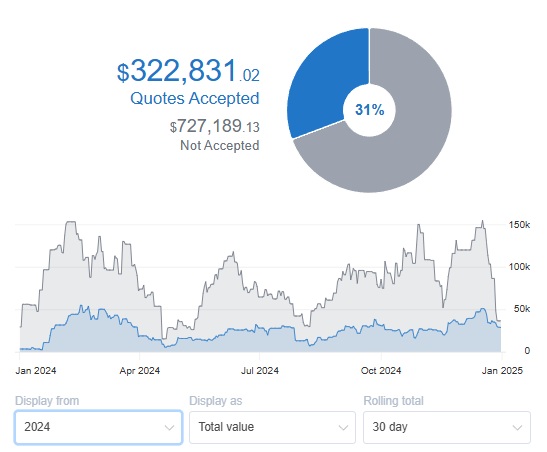

The rule in one sentence
"If you're winning more than 1 in 2 quotes, you're almost certainly underpriced. The optimal win rate is 1 in 3."
Most tradies treat a high win rate as a sign of success. It isn't. When every customer says yes, the market is telling you your price is fair or cheap relative to the alternatives. You have room to raise rates. The customers you lose by raising rates aren't the ones whose jobs were profitable enough to take anyway.
A 1-in-3 win rate means you're winning the jobs that are worth winning — at the right margin — and turning down the ones that would have eroded it. That's not losing business. That's running a healthy business.
A high win rate combined with a full calendar and thin profits is one of the most common traps in the trades. You're flat out busy. You feel like you're performing. But the bank balance says otherwise. The win rate is almost always the culprit.
What different win rates actually mean
| Win Rate | Diagnosis | First Move |
|---|---|---|
| Over 50% | Almost certainly underpriced | Raise rates incrementally until win rate settles at 1 in 3. Every job won at the old rate is margin left on the table. |
| 25–35% | Optimal ✓ | Review rates annually. Increase by CPI + 2–3% minimum. If it creeps above 40% without a price change, raise rates. |
| 15–25% | Marginal — investigate process first | Check response time, quote speed, follow-up count before adjusting price. Often a process fix, not a pricing fix. |
| Under 15% | Systemic failure — full diagnostic required | Audit in order: lead quality → response time → quote speed → presentation → follow-ups → then price last. |
Over 50% is not a success story. It's a warning sign.
Every job you won at the old rate is margin you left on the table. And you were probably running yourself ragged to service work that shouldn't have been viable. The jobs you lose by raising rates were your least profitable ones.
How most tradies measure win rate wrong
Most operators count enquiries, not formal quotes. Someone calls asking "how much does it cost?" — that goes in the pipeline as a lead. When they don't book, the win rate drops. But they were never a genuine prospect.
Measure win rate against formal quotes sent — professional, itemised, written quotes. If you sent 10 quotes last month and won 3 jobs, your win rate is 30%. That's the number that matters.
Most job management tools with built-in quoting track this automatically. We've compared the best quoting software for tradies if you want to see what's out there.
The tool that actually lets you track this
I've been using a dedicated quoting package for my trade business since 2015 — and it's the single biggest reason I can tell you any of this with confidence. When you're sending quotes through Xero's default templates, you're flying blind. No open tracking, no conversion data, no idea what's working and what isn't. You're guessing.
We've been sending quotes with embedded video walkthroughs and images for years. Clients love it. It looks professional, it builds trust before you've even met them on site, and — critically — it gives you real data on who opened your quote, how long they looked at it, and whether they came back for a second look. That's how you actually map your conversion rate instead of just estimating it from memory.
🤝 Coming soon: We're currently in talks to lock down an exclusive deal on this quoting tool for Tradie Scaler readers — expecting to have it finalised by mid-May 2026. If you want to be first to know when it drops, keep an eye on our tradie quoting app comparison.
Don't make big calls on small samples
This is the part most people skip — and it's the part that stops you making panic decisions that cost you money. You need a long enough time horizon to trust the number. A bad week doesn't mean your business is broken. A bad quarter might.
If you're a high-volume operator pumping out 30–50+ quotes a week, you can read the data in real time. A week of results at that volume is genuinely telling you something. But most trade businesses aren't running at that pace. My business was turning over 5–7 jobs a week. At that volume, I used to review my win rate and make major system changes quarterly — not weekly, not monthly. Quarterly gave me enough data points to separate noise from signal.
The smaller your sample, the longer you need to wait before pulling the trigger on changes. A rough guide:
| Your Volume | Minimum Review Window | Why |
|---|---|---|
| 30+ quotes/week | Weekly | Enough data to spot real trends fast |
| 10–30 quotes/week | Monthly | Need 40–100+ data points before acting |
| Under 10 quotes/week | Quarterly | Anything shorter is just noise |
The goal is to give yourself enough quotes in the sample that one weird week — a public holiday, a rainy month, a run of tyre-kickers — doesn't send you into a spiral ripping everything apart for no reason.
What to do — by win rate range
Raise rates by 5–10% immediately. Don't apologise. Don't over-explain. Give existing clients 30 days notice framed around investment in your team and processes — never around your rising costs. Monitor for 4–6 weeks. If win rate drops to 35–40%, hold. If still above 40%, raise again. Keep going until it settles at 1 in 3.
The psychological barrier here is real. Most tradies have never deliberately raised rates and fear losing clients. The truth: the clients you lose when raising rates were squeezing your margin the hardest. The ones who stay are your real customer base — and they're now more profitable than before.
Protect it. Review rates every 12 months without exception — put it in the calendar now. Increase by at least CPI plus 2–3% every year whether it feels necessary or not. Not raising rates annually is a pay cut in disguise because everything that runs the business costs more each year whether your charge-out rate moves or not.
Watch for the win rate creeping upward over 6–12 months without a price change. That's the market telling you your relative price has dropped. Respond with a rate increase, not a celebration.
Before touching price, audit your process in this exact order: (1) Is first contact happening within 30 minutes of an enquiry? (2) Is the quote going out within 48 hours? (3) Are you doing 2+ structured follow-ups after every quote? These three process fixes alone can move a 20% win rate to 30% without any pricing adjustment.
A CRM or job management tool with auto-follow-up on unsigned quotes can move your win rate materially within 30 days. We've reviewed the best CRM apps for tradies that do this automatically.
Don't adjust price until you've audited the entire pipeline. Work in this exact order: lead source quality → first contact speed → quote speed → quote presentation quality → follow-up count → then price last. Under 15% is almost never a pricing problem. There is a process failure somewhere upstream and adjusting price before finding it makes nothing better.
If you lower prices at under 15% win rate, you'll win more low-margin jobs and erode the business faster. Get the process right first.
The exception: a sudden wave of rejections
I just told you not to panic on small samples — and I meant it. But there's one exception. If you've sent out a burst of 15–20 quotes in a short window and you're getting a sudden, freakish wave of rejections, that's not normal variance. That's something breaking.
When that happened to us, it was almost never a pricing problem. Almost every time it came back to one of these:
- A tech failure — our business line ringing out, calls going to voicemail, or the website going down without anyone noticing
- A template issue — our quote template had gone stale, poorly represented our offer, or someone had accidentally broken the formatting
- A follow-up gap — the VA had changed their process, emails were landing in spam, or the second-touch template had been skipped entirely
- A double whammy — and sometimes you cop it all at once. We once had Telstra randomly reroute our 1300 number to another business at the same time our website went down. Chaos. Total loss of trust with anyone trying to reach us that week. You can't make this stuff up.
That's business. Curveballs happen. The important thing is keeping a level head and not blaming the market when the problem is sitting inside your own systems.
The full process audit — test everything as the customer
When you hit one of those moments — a run of lost deals that doesn't feel right — stop guessing and walk your entire process from start to finish as the end user. Actually do it:
- Call your own business line. Does it ring? Does it go to the right place? What happens when you go on hold? Is the hold message still relevant or is it playing a Christmas greeting in April?
- Get your VA to email you. Read it as a customer. Is it clear? Professional? Does the first-contact template actually make you want to reply?
- Get your VA to send you the follow-up templates. The first touch, the second touch, the "just checking in." Read them all with fresh eyes. Are they any good?
- Audit the email trails of deals you lost. Go back through them. Where did the conversation die? Was it after the quote? After the follow-up? Was there even a follow-up?
- Check your phone system and any call forwarding. Telcos change things without telling you. Verify it's actually working.
- Load your own website on mobile. Is the contact form working? Does the number click-to-call? Is anything broken?
Rip it all apart. Every single touchpoint. Because here's what I found every time I did this — you don't just fix the thing that broke. You see every process with completely new eyes. You spot inefficiencies and gaps you hadn't thought about in months, sometimes years. Things you'd stopped noticing because you were too close to them.
A full process audit after a bad run isn't just damage control. It's one of the highest-leverage things you can do for your business. Schedule one quarterly whether things are going well or not.
This is just the start
Your win rate is one number. An important number — maybe the most important diagnostic number in your business — but it's one lever in a much bigger machine.
If you stick around here long enough and commit to doing your quarterly tune-ups, I promise you we'll level up your business together. Not with hype or fluff. With bolt-ons that actually save you time. A growth flywheel that compounds. Better VA comms so your team sounds as good as you do. Systems that refine your conversions, bring in more leads, and give you the confidence to charge what your time is actually worth.
Sound good? Good. Start with this page. Do the audit. Then come back for the next one.
Want to know exactly where your win rate sits — and what to do about it?
The Strategy Builder benchmarks your numbers against the national average for your trade and identifies your first move.
Build My Free Strategy →Frequently Asked Questions
The optimal win rate is 25–35% — approximately 1 in 3. A win rate above 50% almost always means you're underpriced. Below 15% signals a systemic process problem that needs investigating before adjusting price. The 1-in-3 target applies across most residential and light commercial trade work.
When every customer says yes, the market is telling you your price is fair or cheap relative to the alternatives. You have room to charge more. A win rate of 1 in 3 means you're winning the right jobs at the right margin — and letting go of the ones that would have eroded your profitability. The jobs you lose by raising rates were never your best jobs.
Don't touch your price. Investigate the process first in this order: How quickly are you responding to leads? How fast is the quote going out? How many follow-ups are you doing? One or two process fixes upstream often solve a low win rate entirely without any pricing adjustment. Under 15% is almost never a pricing problem.